St Valentine's Day and Widows
What if you are a widow? How do you handle your first Valentine's Day? When I first spotted them, she had her arm on his shoulder, and then she moved her hand down, he then...



Lamborghini sent us a champagne bottle in a briefcase.
The bottle was the gift. The briefcase, it turned out, was the problem — latched shut and lying flat, it looked like luggage. Something you'd check at an airport, not something you'd want to open at a desk with everyone watching.
So we took the bottle out and built it into a basket. Standing upright, the way a champagne bottle ought to, surrounded by things worth opening it for.
And that one bottle is really the whole gift baskets versus gift boxes question. It was never about taste. It's about what your gift actually is, physically, sitting in a room.

Most comparisons of gift baskets and gift boxes stop at how they look — rustic or modern, traditional or clean. That's decoration, and it skips straight past the difference that actually decides which one you should send.
Here's the simplest way we know to put it.
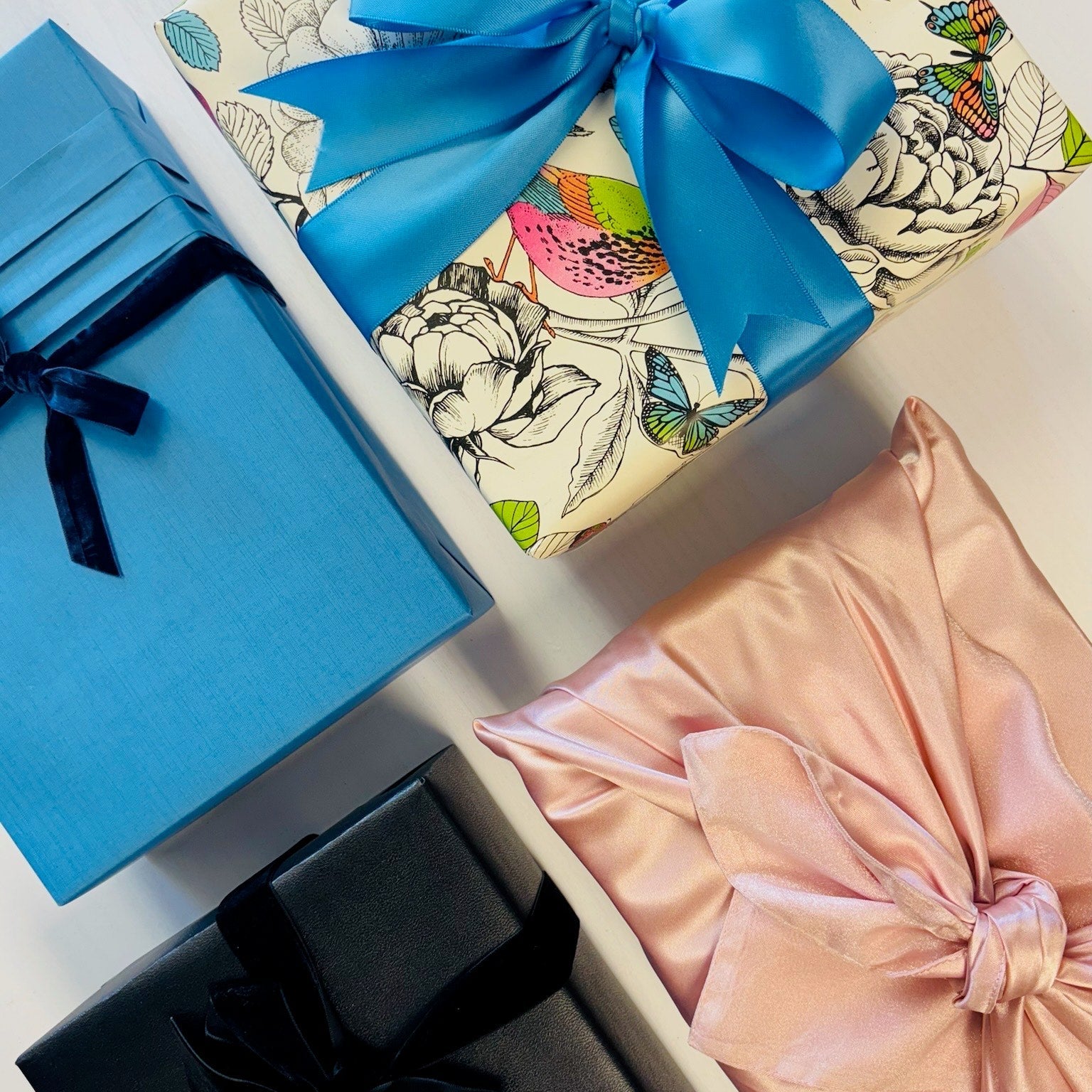
A box is a container. It holds your gift for the trip from your hands to theirs. Then it gets flattened and recycled, and the gift is whatever was inside it.
A basket is a vessel. It holds things, and then it keeps on holding things — on a kitchen counter, a desk, a shelf by the door. The basket isn't the wrapper around the gift. It's part of it.
There's a second difference too, and this one happens before anyone has read the card.
That rigid box with the magnetic closure? It's a borrowed look. Matte, minimal, perfectly uniform — it belongs to companies that manufacture what goes inside it, and it works beautifully for them, because they did. When a gifting company reaches for the same vocabulary, it ends up saying the opposite of what it meant to: that the packaging came off a shelf.
A basket can't be mistaken for manufactured. Somebody's hands arranged it, and you can tell — which hands, and in what order. For a corporate gift, where the whole point is we thought about you specifically, being visibly made by a person isn't a style choice. It's the message.

We build baskets. We'll still tell you when a box is the better call, because sending the wrong format to the wrong person costs more than either format does.
So here's when we'd point you toward a box.
When you're sending volume, and it's all identical. Five hundred boxes with the same four things inside, going to the same kind of person — that's a box job, and we'd say so. Boxes pack faster, they stack in a warehouse between campaigns, and they're easier to check because every one of them is the same. A basket gets assembled by hand, and five hundred hands' worth of work costs more than five hundred lids.
When your items are flat. A gift card, a notebook, a scarf, a framed print. Things that lie down want a box. Put flat items in a basket and you'll end up with a basket that looks half empty — and a half-empty basket reads as a smaller gift than it actually is.
When the recipient's mailroom has rules. Some offices can't accept anything that doesn't arrive sealed and uniform. Financial services and government in particular. Always worth asking before you design anything.
If your gift is four flat items going to five hundred people, send a box. You don't need us to tell you otherwise.
It handles height, and awkward shapes. A champagne bottle stands up in a basket. In a box it has to lie on its side, which means the box has to be as long as the bottle, which means a long flat parcel that tells the recipient nothing at all. Candles, grow kits, wine, tall tins — anything with a shape to it. A basket arranges them. A box just files them.
It holds more without looking crowded. Our Comfort Care sympathy basket carries thirteen items — a throw blanket, a Modern Sprout eucalyptus grow kit, a stoneware mug, Big Heart Tea Co. minty white tea, Lark Fine Foods cookies, a Firefly candle, and more besides. Stack thirteen items in a box and you've got a packing problem. Arrange them in a basket and you've got abundance.
The basket survives. Clients tell us about baskets we sent three years ago that still sit on a kitchen counter holding fruit. The box from that same campaign went out with the recycling that night. One of those two gifts is still working for the brand that sent it.
It opens as a display. A box opens downward, into itself. A basket is already open. Set it on a conference table and the whole gift is visible at once, to everyone in the room — which matters more than it sounds like it should, because corporate gifts get opened in front of an audience more often than not.
And it photographs. Which isn't vanity. If you're sending gifts to clients, creators or press, somebody is going to photograph it. A basket photographs as an arrangement. A box photographs as a lid.
"But baskets don't ship." We hear that one constantly, and it's about a decade out of date.
Ask most gifting companies about shipping and they'll talk to you about transit times. Ask us and we'll talk about the thirty seconds after the outer box comes off.
That's the only moment that really matters. Nobody remembers that a gift took three days to get there. Everybody remembers opening something that shifted on the way — the bottle leaning, the ribbon crushed, an arrangement that was clearly beautiful when somebody built it and isn't anymore.
We ship nationwide from California, and New York, Florida, Texas and Colorado are our biggest markets outside the state. We recently sent out two custom baskets, one at $400 and one at $500, each one built for a single person. At that price there's no acceptable margin for arriving rumpled.
Getting a basket to open the way it was built is the hardest part of this whole business. It's also the part we're best at.
What is true is that shipping a basket costs more than shipping a box. That's a real trade-off, and a fair reason to choose a box when you're sending volume. It isn't a reason to believe baskets are a local-delivery-only thing. They aren't — and any gifting company telling you otherwise is describing what they can do, not what the category can.
Skip the aesthetics for a moment and ask yourself one thing.
Is there a hero?
If one thing in your gift is the point — the bottle, the blanket, the thing you'd name first if somebody asked what you sent — then a basket arranges everything else around it and keeps that hero visible and upright. A box buries it in the packing.
If there's no hero, and your gift is a set of equals in similar shapes, a box presents them beautifully and costs less to make.
Lamborghini had a hero. It was a champagne bottle, and it was lying on its side inside a latched case where nobody could see it until the moment it was handed over. The basket didn't change the gift at all. It changed what the gift looked like before anyone opened it.
If you'd like to see how the arranging actually works, we broke the whole process down in how to build a luxury gift basket, step by step.

The Lamborghini basket started with something the client already owned. That happens more often than you'd think — a brand has a product, a bottle, a sample set, some branded merchandise, and no good way to turn it into something a person actually wants to receive.
That's a different service from buying a basket off a shelf. You ship us the product, we brand it, build the gift around it, and send it wherever it needs to go. Our kitting and gift fulfillment service starts at twenty-five units, and we warehouse client inventory between campaigns, so a recurring programme doesn't have to start from zero every quarter.
A basket is usually the right format for these, for the reason above — your product is the hero, and a basket is built to arrange things around a hero.
One more thing worth saying out loud, because the same word covers two very different products.
Most gift baskets sold in America are made in advance. Assembled, shrink-wrapped, warehoused, and shipped out when the order comes in. The gift message gets printed on the packing slip. Nobody touches it after the machine does.
That's a real product, and it's priced accordingly. It just isn't what we make.
Ours are built for the order. The contents are chosen for the person receiving them, arranged by hand, wrapped by hand — and the note is written by hand, in ink, by someone who read what you wanted it to say.
If something's out of stock we'll substitute, and we'll tell you what we changed. That's the trade for building to order instead of pulling a finished box off a shelf.
Send a box when your contents are flat, identical, high in volume, or headed somewhere with strict parcel rules.
Send a basket when there's a hero item, when the shapes are awkward, when it'll be opened in front of other people, or when you'd like the thing you sent to still be sitting in their kitchen next year.
And if you're torn, go back to the hero question. It settles things more often than budget does.
Our corporate gift baskets are built by hand in California and ship nationwide. And if you've got a product of your own that needs building into one, tell us what you're working with — we'll tell you honestly whether it wants a basket or a box.
0 comments

